
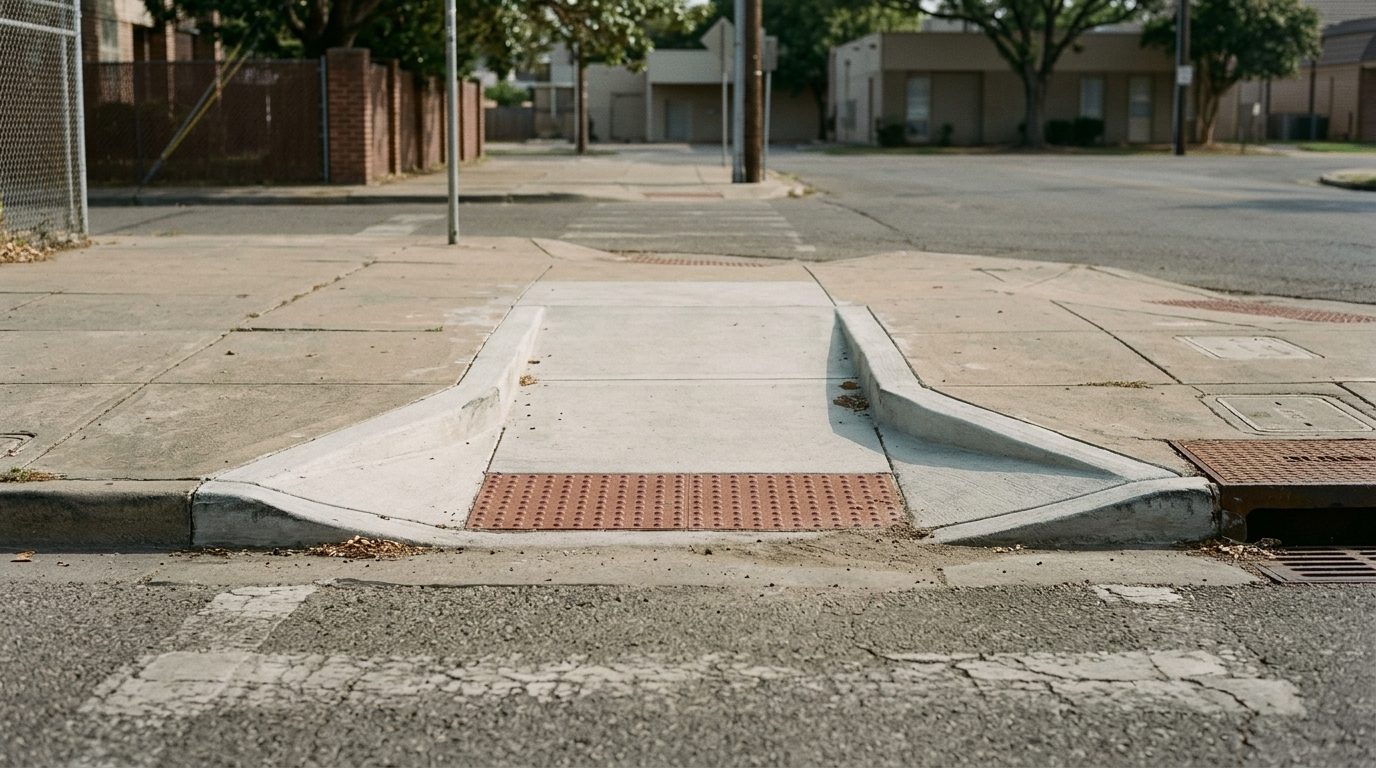
A curb ramp is the sloped section that connects a sidewalk to the street at a crossing. For someone using a wheelchair, a walker or a stroller, it’s the difference between crossing the street and not being able to. A good one barely gets noticed. A bad one can stop a trip.
This guide explains the main parts of a curb ramp, what federal accessibility guidelines say about them, and the problems to look for.
The parts of a curb ramp
- The ramp run: the sloped surface itself.
- The landing: a flat area at the top, where you can turn or wait.
- Flared sides: gently sloped sides where people might walk across the ramp.
- The detectable warning surface: the panel of small raised bumps near the street edge.
- The gutter transition: where the ramp meets the street.
What federal guidelines call for
The US Access Board’s Public Right-of-Way Accessibility Guidelines set out how new and altered curb ramps should be built. For a common “perpendicular” curb ramp, they include (US Access Board, R304 and R305):
- A gentle slope: a running slope of no more than 1:12 (about 8.3%), meaning at least 12 inches of length for every inch of rise.
- A nearly flat side-to-side slope: a cross slope of no more than about 2.1%, so a wheelchair doesn’t tip sideways.
- Enough width: at least 48 inches, not counting flared sides.
- A landing where you change direction: at least 48 by 48 inches at the top when you have to turn to use the ramp.
- Gentle flared sides: no steeper than 10% where people walk across the side of the ramp.
- No changes in level on the ramp surface itself, and flush transitions where slopes meet.
- Placement within the crosswalk, so the ramp leads you into the marked crossing, not into traffic beside it.
- A detectable warning surface of truncated domes that contrasts visually with the surrounding surface, at least 24 inches deep and as wide as the ramp.
These are design rules for new and altered facilities, and how they apply depends on where you live. They’re a useful checklist for spotting a ramp that isn’t working.
Why the bumps matter
The raised bumps, called truncated domes, tell people who are blind or have low vision that they’re about to enter the street, where a curb would otherwise have warned them. That’s why the guidelines call for them to contrast in color with the surrounding concrete and to span the full width of the ramp.
Common curb ramp problems
- No ramp at all at a crossing.
- A lip at the bottom where the ramp meets the gutter, catching small front wheels.
- Too steep, either down the ramp or side to side.
- Water or debris collecting at the bottom, often from poor drainage.
- A ramp that points into the middle of the intersection instead of into the crosswalk.
- Missing, worn or low-contrast warning bumps.
- Obstacles on the landing, such as poles, signs or trash cans.
Report a bad or missing ramp
Note the exact corner (for example, “northeast corner of Main and 5th”), what’s wrong, and take a photo from a safe spot. Report it to your city’s 311 or public works department. Because curb ramps are an accessibility issue, you can also contact the city’s ADA Coordinator; our guide on how to report a street hazard explains how to find them.
Related guides
- Common sidewalk barriers for wheelchair users and how to report them
- What makes an intersection dangerous for pedestrians
- Walking safely through a construction zone
Sources
- US Access Board, Public Right-of-Way Accessibility Guidelines, Chapter 3 (sections R304, Curb Ramps and Blended Transitions, and R305, Detectable Warning Surfaces)
This guide is general information, not legal, medical or engineering advice. Rules and processes differ by city and state. In an emergency, call 911.