
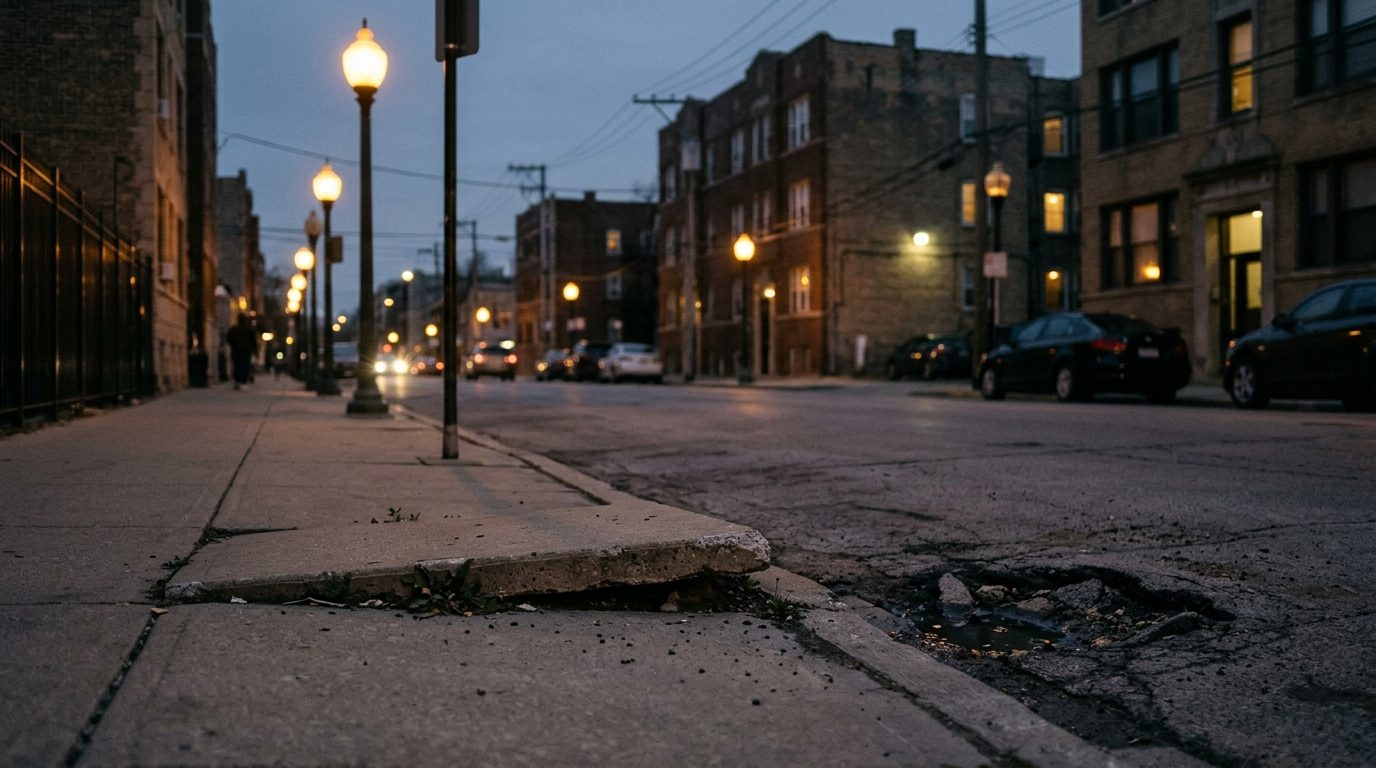
A broken sidewalk, a dead streetlight or a deep pothole usually stays that way until someone tells the people responsible. Cities inspect their streets, but no inspection program sees every block every day. When you report a street hazard clearly, as someone who walks or drives past it, that is often what gets it onto a repair list.
This guide explains how to report a street hazard in a way that is quick for you and easy for a city to act on. It applies to most US cities and towns, though the exact phone numbers, apps and response times differ from place to place.
Before you report: your safety first
Never step into traffic to look at, measure or photograph a hazard. Take your photo from the sidewalk or another safe spot, and come back in daylight if you need a better look.
Some problems are emergencies, not repair requests. A fallen power line, a large hole that has opened in a busy road, a gas smell or anything that puts someone in immediate danger needs a call to 911, not a routine report.
Step 1: Note the exact location
The single most useful thing in any report is a precise location. A repair crew can’t fix what it can’t find.
Write down:
- The street name and the nearest house number or business address.
- The nearest cross street.
- Which side of the street the hazard is on, and roughly where (for example, “in front of the driveway” or “at the corner curb ramp”).
If your city’s reporting app lets you drop a pin on a map, use it, and still add a written description.
Step 2: Take a clear photo
A photo removes guesswork. If you can, take two:
- A close-up that shows the problem itself, ideally with something for scale, like a shoe, a coin or the edge of the curb.
- A wider shot that shows where it is, such as the nearest building, sign or corner.
Describe what you see rather than what you think caused it. “A sidewalk slab raised about an inch above the next one, at the corner of Elm and 3rd” is easier to act on than “the tree ruined the sidewalk.”
Step 3: Find your city’s reporting channel
If your city has 311
311 is a three-digit number that the Federal Communications Commission set aside in 1997 for non-emergency calls to police and other government services (FCC Order 97-51). Using it is optional for each community, so not every city offers it. Cincinnati, for example, explains on its own site that it adopted 311 for non-emergency city services alongside its regular phone numbers (City of Cincinnati).
Where 311 exists, it often comes with a website or app where you can attach photos and track your request.
If it doesn’t
Search for your city’s name plus “report a problem,” “service request” or “public works.” Most cities list a phone number, an online form or both.
Who owns that piece of street?
The right channel depends on who is responsible for the spot:
- Local streets and most sidewalks are usually handled by the city or town, though in many places the property owner next to a sidewalk must repair it. Our guide on who is responsible for repairing a broken sidewalk explains how that works.
- State highways that run through town are often maintained by the state transportation department, even when they look like ordinary city streets.
- Streetlights may belong to the city or to a power utility. Many poles carry a small ID tag; note the number if you see one. Our guide on reporting a broken streetlight covers this in more detail.
If you’re not sure, report it to the city anyway. Many cities forward reports to the right agency.
Step 4: Say what it is and why it matters
A good report answers three questions: where exactly, what exactly, and how bad.
Include details like these when they apply:
- Whether the hazard blocks a path for people using wheelchairs, walkers or strollers.
- Whether it is near a school, bus stop, hospital or crosswalk.
- Whether it is getting worse (for example, a pothole that has grown over several weeks).
Step 5: Submit it and keep the reference number
Most reporting systems give you a ticket, case or reference number when you submit. Save it, along with the date and a copy of your photo.
Step 6: Follow up if nothing changes
Response times vary a great deal between cities, and between kinds of hazards. If the problem is still there after a reasonable wait, contact the same channel again and quote your reference number. Many systems let you check the status online.
If a neighbor has reported the same problem, an additional report usually doesn’t hurt, and it can show the city that the issue affects more than one person.
When the hazard is an accessibility barrier
If a broken sidewalk, missing curb ramp or blocked path prevents people with disabilities from getting around, there is an additional route. Under Title II of the Americans with Disabilities Act, state and local government agencies with 50 or more employees must have a grievance procedure and a staff member who handles ADA issues, often called an ADA Coordinator (Mid-Atlantic ADA Center). Their contact details should be available to the public, often on the city’s website.
You can also file an ADA complaint against a state or local government with the US Department of Justice. The Mid-Atlantic ADA Center notes that complaints to federal agencies must be filed within 180 days of the alleged discrimination.
Some cities run their own accessibility repair programs. Los Angeles, for example, created an Access Request Program that prioritizes sidewalk and curb ramp repairs requested by or for people with mobility disabilities (Western City Magazine). Check whether your city offers something similar.
Our guide to common sidewalk barriers for wheelchair users explains which barriers to look for.
A quick checklist
- Safe spot, no traffic.
- Exact location, with cross street and side of the street.
- Close-up and wide photos.
- The right channel: 311, the city’s form, the state or a utility.
- What it is, who it affects, and whether it’s getting worse.
- Save the reference number. Follow up if needed.
Related guides
- How to report a pothole and what happens next
- Sidewalk trip hazards: how to spot uneven slabs, cracks and lifted edges
- How to report a broken streetlight
Sources
- Federal Communications Commission, Use of N11 Codes and Other Abbreviated Dialing Arrangements, FCC 97-51
- City of Cincinnati, What is the purpose of the 311 telephone number?
- Mid-Atlantic ADA Center, ADA Enforcement Options: Title II
- US Department of Justice, File a Complaint
- Western City Magazine, Los Angeles Launches a $1.4 Billion Sidewalk Repair Program (2018)
This guide is general information, not legal, medical or engineering advice. Rules and processes differ by city and state. In an emergency, call 911.