
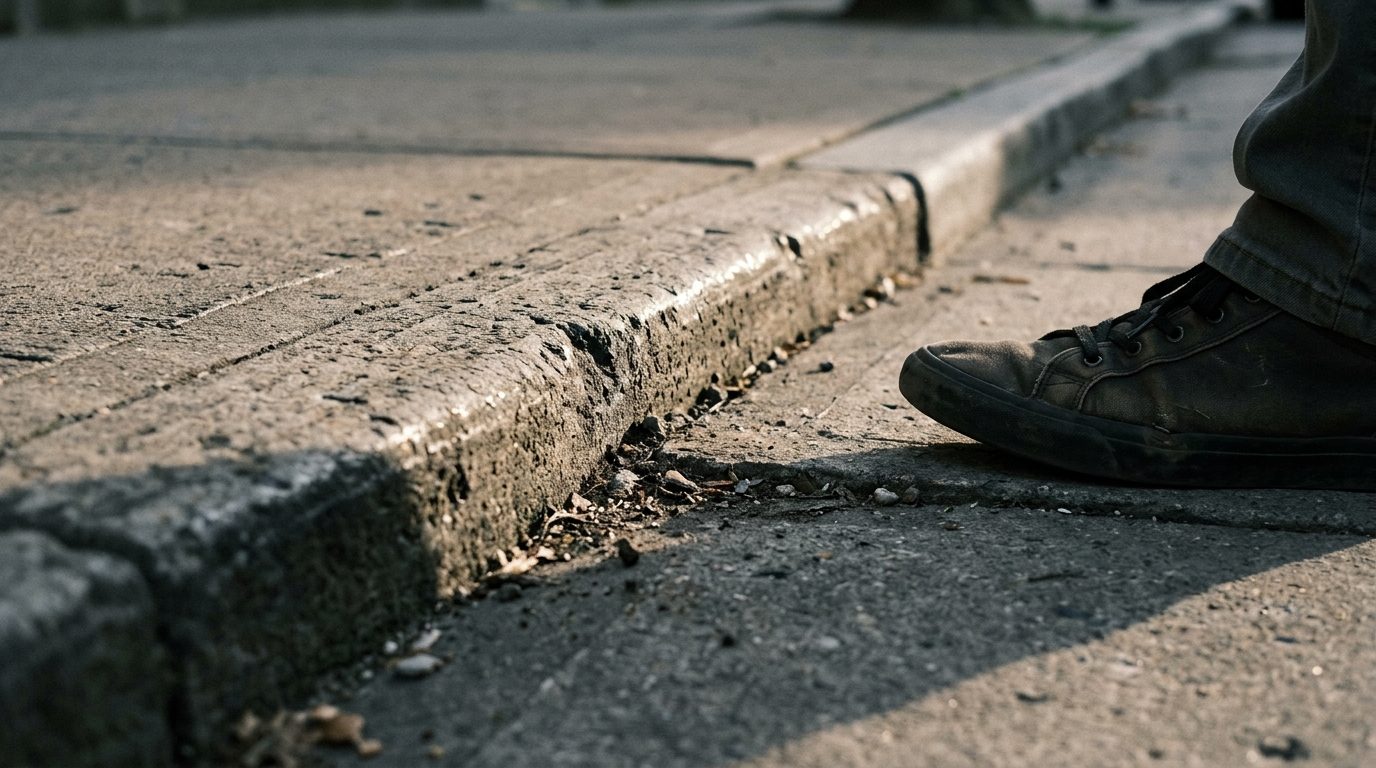
Most falls on sidewalks don’t start with anything dramatic. They start with an edge a little higher than the one before it, a crack wide enough to catch a heel, or a metal cover sitting just above the concrete. Sidewalk trip hazards are easy to miss precisely because they are small.
This guide explains what to look for, why small changes in height matter, and how to get around hazards safely until they’re fixed.
What counts as a trip hazard?
A trip hazard is any spot where the walking surface changes suddenly in a way your foot doesn’t expect. On sidewalks, the most common forms are:
- Lifted slabs. One concrete square, or “flag,” sits higher than the next. Tree roots, frost and settling soil are common causes.
- Sunken or tilted slabs. A section has dropped or tipped, leaving a raised edge on its neighbor or a slope that pitches you sideways.
- Wide or deep cracks. Gaps that can catch a heel, the tip of a cane, or a wheelchair caster.
- Crumbling edges and holes. Broken concrete at joints, curbs and driveway aprons.
- Raised hardware. Utility covers, valve boxes and grates that stick up above the surrounding surface.
- Patchwork. Repairs made with a different material that has worn unevenly.
New York City’s Department of Transportation lists several of these, including trip hazards, improper slopes, patchwork, collapsed sections and hardware trip hazards, among the sidewalk defects it can cite (NYC DOT).
Why small height changes matter
It’s tempting to think only big, obvious bumps are dangerous. Accessibility guidelines suggest otherwise.
The US Access Board’s Public Right-of-Way Accessibility Guidelines, which set out how new and altered sidewalks should be built, allow a vertical change in level of only 1/4 inch. Changes between 1/4 inch and 1/2 inch must be beveled, with a slope no steeper than 1:2. Anything taller than 1/2 inch needs a gentler ramp-like slope (US Access Board, R302.6.2).
Those numbers are design rules for accessible routes, not a legal definition of when a sidewalk becomes “dangerous.” But they show how little it takes to create a barrier: an edge about the thickness of a pencil is already the limit for a vertical step. For someone using a wheelchair, a walker or a cane, or anyone carrying bags or watching traffic, a half-inch lip can be the difference between a smooth step and a stumble.
Where trip hazards tend to appear
Some places on a sidewalk deserve a closer look:
- Next to street trees. Roots can lift slabs from below, often raising one edge more than the other.
- At driveways and curb cuts. Heavier loads and changing slopes stress the concrete.
- Around utility covers and grates. Settling around a fixed object leaves it sticking up.
- Where old and new concrete meet. Repairs don’t always line up with the original surface.
- In shaded or poorly lit spots. A hazard you could see easily at noon can vanish at dusk. Our guide on why street lighting matters explains more.
How to walk around trip hazards
Until a hazard is fixed, a few habits lower your risk:
- Look a few steps ahead, not just at your feet, especially on familiar routes where it’s easy to stop paying attention.
- Be careful when lighting changes, such as walking from bright sun into shade, or at dusk.
- Watch the edges. Lifted slabs are often worst at one corner.
- Give yourself time. Rushing to make a crossing signal is when small hazards catch people out.
- Choose shoes with a secure fit if you know a route has rough patches.
If you use a mobility device or walk with someone who does, our guide to common sidewalk barriers for wheelchair users covers obstacles that matter most for rolling travel.
What to do when you find one
A hazard that gets reported has a far better chance of being fixed. Note the exact location, take a photo with something for scale, and report it to your city. Our step-by-step guide on how to report a street hazard walks you through it.
Who actually repairs it depends on where you live. In some cities the city fixes sidewalks; in many others, the owner of the property next to the sidewalk is responsible. Our guide on who is responsible for repairing a broken sidewalk explains the difference.
Sources
- US Access Board, Public Right-of-Way Accessibility Guidelines, Chapter 3: Technical Requirements (section R302.6.2, Changes in Level)
- NYC Department of Transportation, Sidewalks
This guide is general information, not legal, medical or engineering advice. Rules and processes differ by city and state. In an emergency, call 911.