
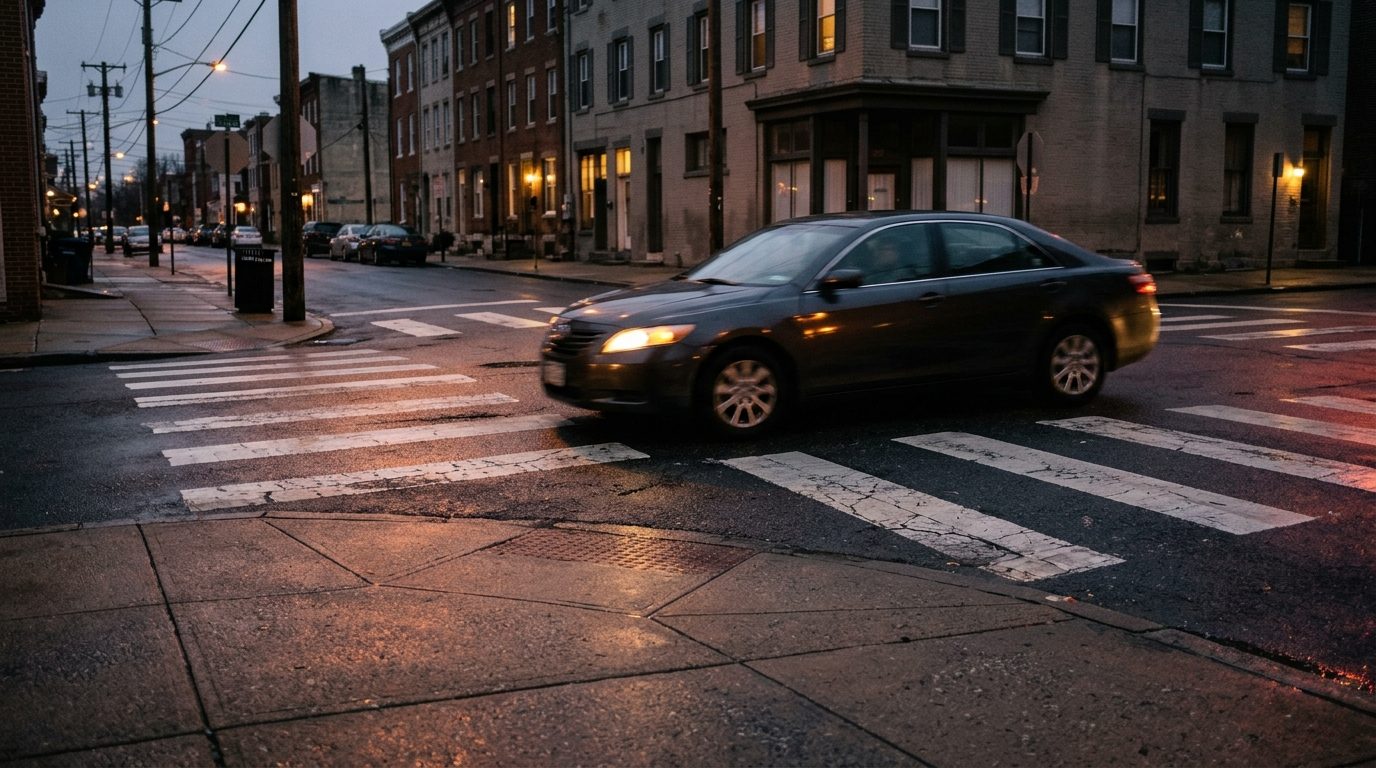
You have the “Walk” signal. A driver has a green light. Both of you are allowed to go, and both of you are heading for the same patch of road. That’s the everyday conflict between turning vehicles and crosswalks at signalized intersections, and it deserves special attention when you cross.
Why turns and crosswalks collide
At many signals, the “Walk” phase runs at the same time as the green light for traffic going the same direction. Drivers turning right or left onto the street you’re crossing must yield to you, but they’re also watching for gaps in oncoming traffic, checking mirrors and judging the turn. A person stepping off the curb can be easy to miss, especially:
- On left turns, where the driver is focused on oncoming cars.
- On right turns, where the driver may be looking left for a gap, not right at the crosswalk.
- At night or in rain, when visibility drops. Our guide on why street lighting matters explains more.
- Around large vehicles, which have bigger blind spots and wider turns.
The fix many cities use: a head start
A leading pedestrian interval (LPI) gives people on foot a few seconds of “Walk” before vehicles get a green light. The Federal Highway Administration describes it as letting pedestrians enter the crosswalk 3 to 7 seconds ahead of traffic, so they’re already visible in the road before drivers start turning (FHWA).
FHWA lists the benefits as more visible pedestrians, fewer conflicts, drivers more likely to yield, and better safety for people who are slower to start crossing. It reports that LPIs can reduce pedestrian-vehicle crashes at intersections by 13%, and notes that its handbook on designing roads for older road users recommends LPIs where many vehicles turn (FHWA). When only the signal timing needs changing, the cost is very low.
If you notice the “Walk” sign coming on a moment before the traffic light turns green, that’s probably an LPI.
Tips for people walking
- Start crossing at the beginning of “Walk.” That’s when you’re most visible and have the most time.
- Look over your shoulder for cars turning from behind you, not just at traffic ahead.
- Make eye contact with turning drivers. If you can’t see their eyes, assume they can’t see you.
- Stay visible: don’t step out from behind a bus, truck or large parked vehicle.
- Keep your phone down while crossing.
Tips for people driving
- Expect people in the crosswalk whenever you turn, especially on a green light.
- Stop and wait until people have cleared your path, not just your lane.
- Look before you turn, then look again. Check the crosswalk you’re turning across, not only the gap in traffic.
- Slow down on turns. A slower turn gives you more time to see and stop.
Report a problem crossing
If drivers routinely turn through a crosswalk while people are crossing, the “Walk” signal seems too short, or a pushbutton doesn’t work, report it to your city’s transportation department. Asking whether an LPI could be added is a reasonable, specific request. Our guide on how to report a street hazard explains how.
Related guides
- What makes an intersection dangerous for pedestrians
- Why street lighting matters for pedestrian safety
Sources
- Federal Highway Administration, Proven Safety Countermeasures: Leading Pedestrian Interval
This guide is general information, not legal, medical or engineering advice. Rules and processes differ by city and state. In an emergency, call 911.