
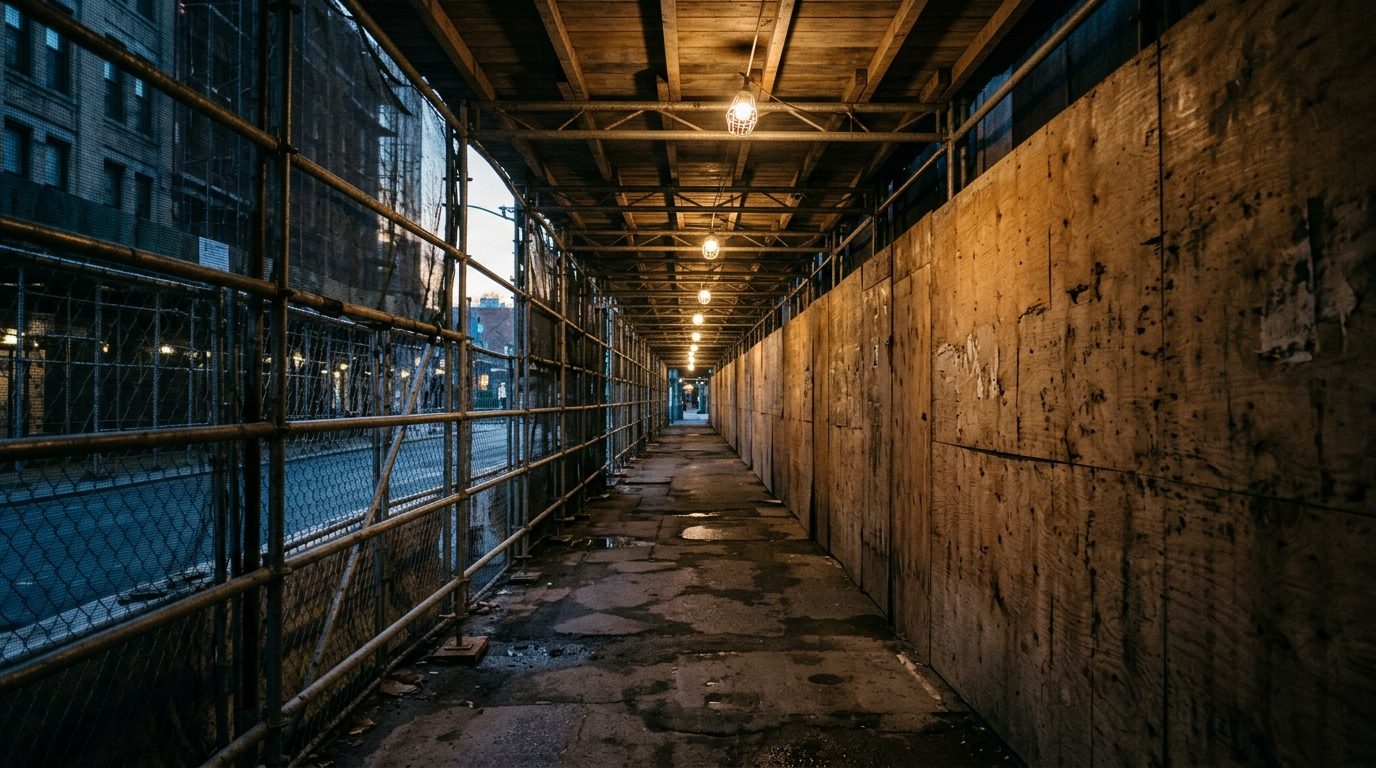
A “Sidewalk Closed” sign can send you onto a narrow temporary path, across the street, or sometimes into the road itself. Construction zones change from week to week, and they’re easy to underestimate when you walk the same route every day.
Work zones are risky for people on foot. Federal Highway Administration figures show that in 2020, 170 people on foot and on bicycles died in work zone crashes, a 21% increase over the year before (FHWA). This guide explains what a safe detour should look like and how to get through a work zone on foot.
What a good pedestrian detour looks like
Federal accessibility guidelines for sidewalks and streets describe what a temporary route around a closed sidewalk should provide. The US Access Board calls this an “alternate pedestrian access route” and sets out, among other things, that (US Access Board, R303):
- Signs should appear before you reach the decision point, not at the closure itself, so you can choose your route early. Audible or other non-visual information should also be provided for people who can’t read the signs.
- The route should be at least 48 inches wide, or as wide as the sidewalk it replaces if it uses an existing path.
- The surface should be as usable as the closed sidewalk, without new trip hazards.
- Where the route crosses a curb, there should be a curb ramp.
- Barriers that mark the route should be detectable by a cane, with a bottom edge no more than 2 inches off the ground and a top at least 32 inches high.
These guidelines apply to new and altered facilities in the public right-of-way and depend on how they’ve been adopted where you live. They’re still a useful yardstick: if a detour falls well short of them, it’s worth reporting.
How to walk through safely
- Plan ahead on routes you know. If a project is starting, check whether your usual sidewalk will close and look for a better route.
- Follow the signed detour. Squeezing past barriers or walking through the work area puts you near equipment and workers who may not expect you.
- Cross at a crosswalk. If the detour sends you across the street, use the nearest marked crossing or signal, even if it’s a short walk out of your way.
- Stay off the phone. Work zones change daily, and the path you used yesterday may be different today.
- Watch for moving equipment. Construction vehicles can be slow to stop and have large blind spots. Make eye contact with operators or flaggers when you can.
- Take extra care at night. Temporary routes are often poorly lit. Our guide on why street lighting matters explains why that’s a problem.
If you use a wheelchair, walker or stroller
Temporary routes are where accessibility often breaks down: a detour with no curb ramp, a plywood path with a lip, or a closure with no signed alternative. If a detour leaves you no usable route, report it to the city and, if needed, to its ADA Coordinator. Our guide to curb ramps explains what a usable ramp looks like.
How to report a bad detour
Note the address, the name of the contractor or project if it’s posted, and what’s wrong: no detour signs, a route that’s too narrow, a missing curb ramp, a blocked path. Take a photo from a safe spot. Then report it to your city’s 311 line or public works department. Our step-by-step guide on how to report a street hazard covers the details.
Related guides
- Work zone driving: signs, speed limits and lane shifts explained
- Curb ramps explained: what a good one looks like
Sources
- US Access Board, Public Right-of-Way Accessibility Guidelines, Chapter 3 (section R303, Alternate Pedestrian Access Routes)
- Federal Highway Administration, National Work Zone Awareness Week: Work Zones are a Sign to Slow Down (2022)
This guide is general information, not legal, medical or engineering advice. Rules and processes differ by city and state. In an emergency, call 911.