
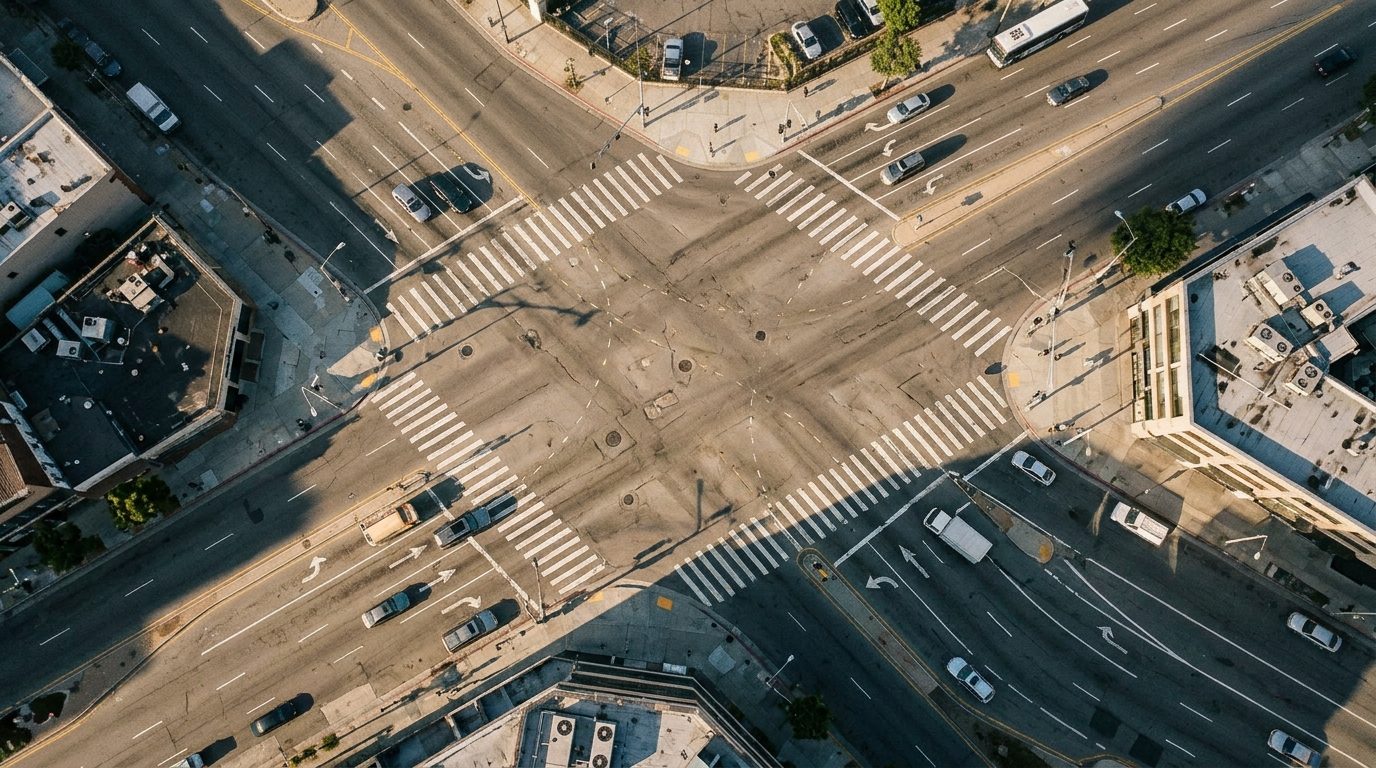
Some intersections feel easy to cross. Others make you hurry, look three ways at once and hope. The difference is rarely luck; it’s mostly design. Knowing what makes dangerous intersections for pedestrians can help you choose safer crossings and describe the problem clearly when you report it.
Intersections are only part of the picture. Federal Highway Administration figures for 2018 show that about a quarter of pedestrian deaths happened at intersections, and most of the rest at mid-block locations away from them (FHWA STEP). But intersections are where people on foot and turning cars meet most often, so their design matters.
Warning signs of a hard-to-cross intersection
Long crossing distances
Every extra lane is more time spent in the road. Wide intersections with many lanes, turn lanes and slip lanes stretch the crossing, and leave little room for error if a signal changes or a driver doesn’t yield.
Signals that don’t give enough time
Federal accessibility guidelines for new and altered crossings call for pedestrian signal timing based on a walking speed of 3.5 feet per second or slower, with a “Walk” interval of at least 7 seconds (US Access Board, R306.2). Older signals, or ones timed mainly for traffic flow, may not meet that, leaving slower walkers stranded mid-crossing.
Lots of turning traffic
When drivers turn on a green light while people are crossing on “Walk,” the two meet in the crosswalk. Our guide on turning vehicles and crosswalks covers this in detail.
Poor visibility
Parked cars close to the corner, overgrown planting, signs and poor lighting can hide a person waiting to cross until a driver is close. At night, the problem gets worse. Our guide on why street lighting matters explains why.
Odd angles and slip lanes
Skewed intersections, where streets meet at an angle, and slip lanes, where right-turning drivers sweep around a corner island, encourage faster turns and make it harder for drivers to see across.
Missing or poor curb ramps
A crossing isn’t usable for everyone if the curb ramp is missing, steep or broken. Our guide to curb ramps explains what a good one looks like.
What engineers can do
The Federal Highway Administration promotes several proven measures for safer crossings through its STEP program, including (FHWA STEP):
- Pedestrian refuge islands, which give people a safe place to stop halfway across, especially helpful for older pedestrians and people with limited mobility.
- Leading pedestrian intervals, which give people on foot a head start before cars get a green light to turn.
- Raised crosswalks, which can slow vehicles down.
- Crosswalk visibility enhancements, such as lighting and stronger signs and markings, which help drivers see pedestrians, particularly at night.
- Road diets, which reconfigure a road to reduce speeds and the number of lanes people have to cross.
- Rectangular rapid flashing beacons and pedestrian hybrid beacons, which help at crossings without a full traffic signal.
How to cross more safely
- Use the crosswalk and the signal, and start crossing at the beginning of “Walk,” not partway through.
- Look for turning vehicles, not just traffic coming straight at you.
- Make eye contact with drivers before stepping in front of them.
- Use refuge islands when they’re there, and wait if you need to.
- Choose a better crossing when one is close, even if it’s a short detour.
Report it
If an intersection doesn’t give you enough time to cross, has a missing curb ramp, or has a pushbutton that doesn’t work, report it to your city’s transportation department or 311. Be specific: which corner, which direction and what happened. Our guide on how to report a street hazard walks you through it.
Related guides
- Turning vehicles and crosswalks: what walkers and drivers should know
- Why street lighting matters for pedestrian safety
Sources
- Federal Highway Administration, Safe Transportation for Every Pedestrian (STEP)
- US Access Board, Public Right-of-Way Accessibility Guidelines, Chapter 3 (section R306, Crosswalks)
This guide is general information, not legal, medical or engineering advice. Rules and processes differ by city and state. In an emergency, call 911.